Design space explored
All comparisons were performed for a one‑arm, fixed‑design clinical trial with a binary primary endpoint. Such designs are often used in rare diseases or early‑phase settings where recruiting a concurrent control group is not feasible. The objective of this section is to compare sample size calculations across software implementations using two types of analyses:
- a Z‑pooled large‑sample test for a single proportion, and
- an exact computation method.
Both approaches were evaluated over the same factorial design space used in the preceding two‑arm sections.
Varying design parameters
The same four parameters were systematically varied:
Type I error rate (\(\alpha\), two-sided):
\(\alpha \in {0.01,\ 0.05,\ 0.10,\ 0.20,\ 0.49}\)
Power (\(1 - \beta\)):
\(1 - \beta \in {0.51,\ 0.80,\ 0.90,\ 0.99}\)
Control (historical) response rate:
\(\pi_c \in {0.10,\ 0.30,\ 0.50,\ 0.80,\ 0.90}\)
Minimum clinically important improvement:
\(\Delta\pi \in {0.05,\ 0.15,\ 0.25,\ 0.49}\)
The experimental response rate target for design purposes was defined as:
\[
\pi_e = \pi_c + \Delta\pi,
\]
and scenarios yielding \(\pi_e > 1\) were discarded. A total of 300 valid design scenarios were evaluated.
Fixed design assumptions
To ensure comparability between methods and isolate software‑level differences, the following assumptions were fixed across all scenarios:
- Design type: one‑arm fixed design
- Test sidedness: two‑sided
- Statistical tests evaluated:
- One‑sample Z-test
- Exact computation method (implementation‑dependent)
- No continuity correction unless imposed by a specific tool
- No interim analyses or stopping rules
- Outcomes: independent Bernoulli variables without overdispersion
No adjustments for stratification, covariates, or missingness were included. The focus is strictly on sample size determination under the assumed null response rate \(\pi_c\).
Relevancy classification of design scenarios
Relevancy was determined using the same rule‑based criteria applied in the two‑arm sections, relying only on α and power:
High relevance
Scenarios satisfying \[
0.02 < \alpha < 0.15 \quad\text{and}\quad \text{power} > 0.75.
\] These constitute realistic one‑arm designs often used in phase II or rare‑disease contexts.
Medium relevance
Scenarios not meeting criteria for high or low relevance, representing plausible but less standard combinations of α and power.
Low relevance
Scenarios with \[
\alpha > 0.20
\quad\text{or}\quad
\text{power} < 0.60
\quad\text{or}\quad
\text{power} \ge 0.99.
\] Such settings are operationally uncommon but included to stress‑test asymptotic and exact methods across extreme operating conditions.
The classification is used purely for interpretability and does not impact sample size computations.
One‑sample Z-test
Methods compared
- East : Single Proportion test [PN-1S-SP]
- nQuery : POT0 / Chi Square Test for One Proportion
rpact::getSampleSizeRates(group = 1)
Results
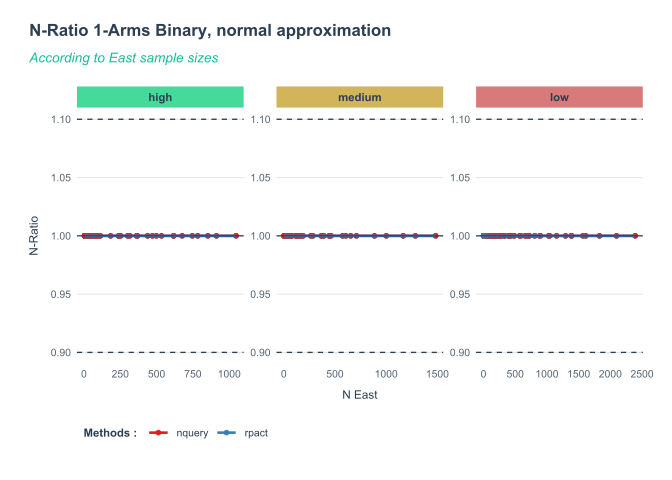
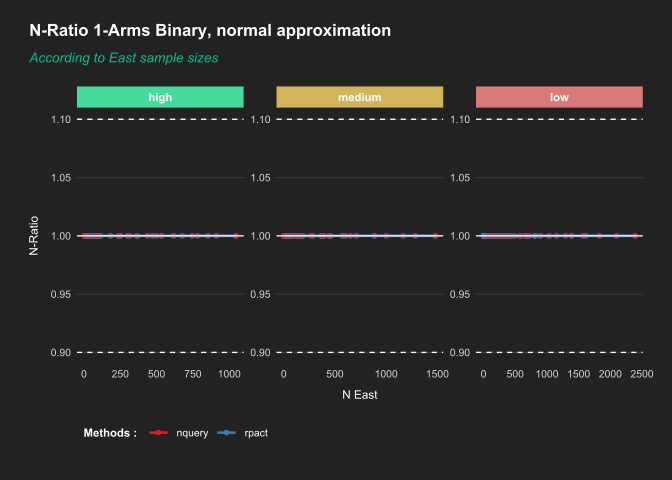
📌Overall: for one‑arm binary fixed designs using the Z‑test, rpact and nQuery are fully concordant with East, yielding identical sample sizes across the full design space.
- Across all relevancy levels,
nQuery and rpact produce identical sample sizes, with N‑ratios effectively equal to 1.00 for every design.
| According to East sample sizes |
| high |
| nquery |
1.00 |
1.00 |
1.00 |
1.00 |
1.00 |
1.00 |
| rpact |
1.00 |
1.00 |
1.00 |
1.00 |
1.00 |
1.00 |
| medium |
| nquery |
1.00 |
1.00 |
1.00 |
1.00 |
1.00 |
1.00 |
| rpact |
1.00 |
1.00 |
1.00 |
1.00 |
1.00 |
1.00 |
| low |
| nquery |
1.00 |
1.00 |
1.00 |
1.00 |
1.00 |
1.00 |
| rpact |
1.00 |
1.00 |
1.00 |
1.00 |
1.00 |
1.00 |
| According to East sample sizes |
| high |
| nquery |
1.00 |
1.00 |
1.00 |
1.00 |
1.00 |
1.00 |
| rpact |
1.00 |
1.00 |
1.00 |
1.00 |
1.00 |
1.00 |
| medium |
| nquery |
1.00 |
1.00 |
1.00 |
1.00 |
1.00 |
1.00 |
| rpact |
1.00 |
1.00 |
1.00 |
1.00 |
1.00 |
1.00 |
| low |
| nquery |
1.00 |
1.00 |
1.00 |
1.00 |
1.00 |
1.00 |
| rpact |
1.00 |
1.00 |
1.00 |
1.00 |
1.00 |
1.00 |
Exact computation
Methods compared
- East : Single Proportion test [PN-1S-SP]
- (A?)’Hern_2001 implementation (see A’Hern validation for more details on implementation)
Results
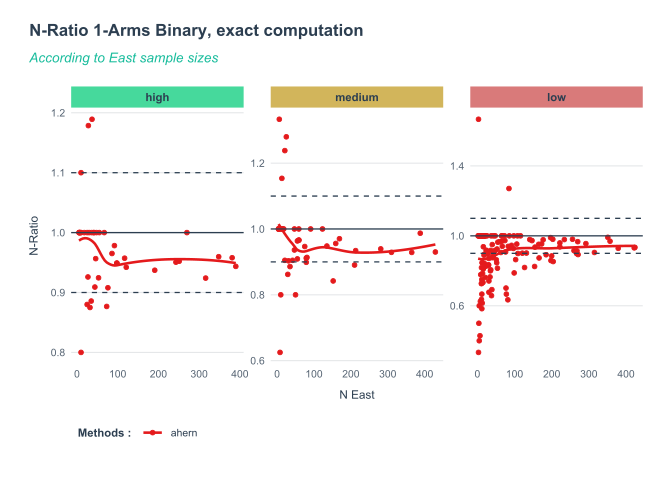
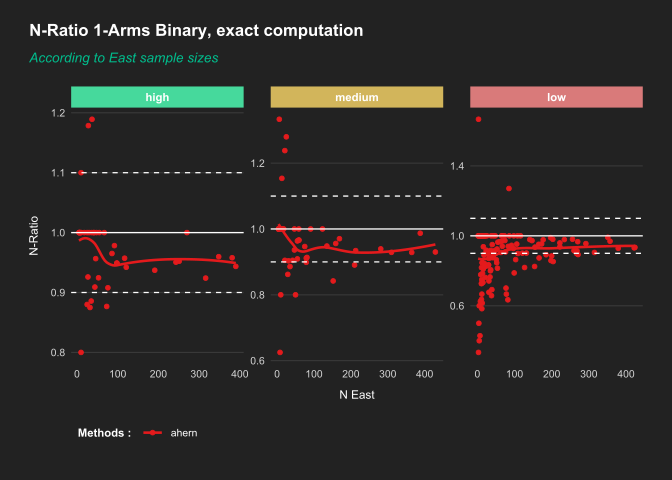
📌Overall: A’Hern increasingly diverges from East as relevancy drops, shifting from mild underestimation to wider underestimation.
- Across all relevancy levels, the A’Hern method shows substantial deviations from East, with N‑ratios ranging from marked underestimation to clear overestimation depending on the scenario.
- In high‑relevancy designs, A’Hern’s sample sizes tend to be slightly smaller than East’s, with ratios mostly between 0.9 and 1.0 but still showing noticeable spread.
- In the medium range, the dispersion increases and the method oscillates more widely around the 1.00 reference, reflecting sensitivity to exact‑test discreteness.
- In low‑relevancy designs, deviations become the largest, with ratios extending well below 0.9.
| According to East sample sizes |
| high |
| ahern |
0.80 |
0.94 |
0.97 |
0.96 |
1.00 |
1.19 |
| medium |
| ahern |
0.62 |
0.91 |
0.96 |
0.95 |
1.00 |
1.33 |
| low |
| ahern |
0.33 |
0.83 |
0.89 |
0.92 |
1.00 |
1.67 |
| Red : < 50% of N-ratios ±10% |
| According to East sample sizes |
| high |
| ahern |
0.80 |
0.94 |
0.97 |
0.96 |
1.00 |
1.19 |
| medium |
| ahern |
0.62 |
0.91 |
0.96 |
0.95 |
1.00 |
1.33 |
| low |
| ahern |
0.33 |
0.83 |
0.89 |
0.92 |
1.00 |
1.67 |
| Red : < 50% of N-ratios ±10% |
Likely source of divergence
A’Hern’s design is based on a single‑stage exact binomial test with integer‑grid optimisation of \((n, r)\) pairs targeting feasibility and minimax or optimality criteria.
East, by contrast, uses an exact unconditional power calculation (not the A’Hern grid search) and optimises \(n\) directly to meet the power constraint.
These two formulations:
- use different objective functions,
- evaluate different rejection boundaries,
- and respond differently to discreteness in the exact binomial test.
Because of these structural differences, A’Hern is not expected to match East, even though your A’Hern implementation is correct (it reproduces the original published tables).
Overall: the observed discrepancies reflect fundamental differences in how exact one‑arm binary designs are defined and optimised.
Interactive results
You can explore all results interactively, filter designs, compare methods, and inspect individual cases in the interactive section of the website.
➡️ “Interactive results”