| N-Ratio 2-Arms Binary GS-design, pooled-variance | ||||||
| According to East sample sizes | ||||||
| Relevancy | Min | Q1 | Mean | Median | Q3 | Max |
|---|---|---|---|---|---|---|
| high | ||||||
| rpact | 0.96 | 1.00 | 1.00 | 1.00 | 1.00 | 1.00 |
| medium | ||||||
| rpact | 0.95 | 1.00 | 1.00 | 1.00 | 1.00 | 1.02 |
| low | ||||||
| rpact | 0.94 | 1.00 | 1.00 | 1.00 | 1.00 | 1.06 |
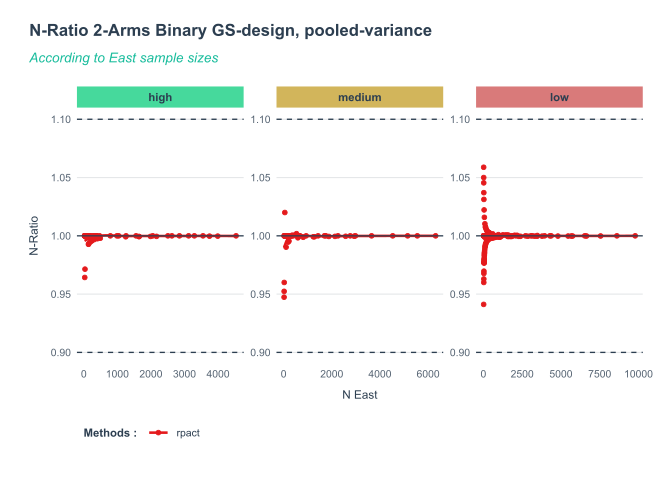
All comparisons were performed for a two‑arm, group‑sequential randomized clinical trial with a binary primary endpoint. The aim was to evaluate the consistency of sample size calculations across commonly used software tools, over the same factorial design space used in the fixed‑design setting.
The same four design parameters as in the fixed-design section were varied:
Type I error rate (\(\alpha\), two-sided):
\(\alpha \in {0.01,\ 0.05,\ 0.10,\ 0.20,\ 0.49}\)
Power (\(1 - \beta\)):
\(1 - \beta \in {0.51,\ 0.80,\ 0.90,\ 0.99}\)
Control-group response rate:
\(\pi_c \in {0.10,\ 0.30,\ 0.50,\ 0.80,\ 0.90}\)
Treatment effect (difference in proportions):
\(\Delta\pi \in {0.05,\ 0.15,\ 0.25,\ 0.49}\)
The experimental-group rate was defined as
\(\pi_e = \pi_c + \Delta\pi\),
and scenarios with \(\pi_e > 1\) were excluded.
A total of 300 valid design scenarios were obtained.
To isolate differences attributable to software implementation and numerical methods, the group-sequential structure was fixed across all scenarios:
Stopping for futility followed a non‑binding rule so that crossing the futility boundary does not inflate the Type I error.
As in the fixed‑design setting, each scenario was assigned a relevancy category based solely on α and power:
High relevance \[ 0.02 < \alpha < 0.15 \quad\text{and}\quad \text{power} > 0.75. \] These settings correspond to realistic, routinely used confirmatory designs—now extended to the group-sequential framework.
Medium relevance
Scenarios falling outside the high and low regions, representing plausible but less typical combinations of α and power encountered in exploratory or early‑phase program designs.
Low relevance \[ \alpha > 0.20 \quad\text{or}\quad \text{power} < 0.60 \quad\text{or}\quad \text{power} \ge 0.99. \] These extreme configurations are not typical for group‑sequential confirmatory trials but are kept intentionally to examine numerical robustness of spending‑function implementations.
The categorization is descriptive and plays no role in filtering or weighting the results; it serves purely to guide interpretation.
rpact::getSampleSizeRates(design = rpact::getDesignGroupSequential)📌Overall: rpact reproduces East’s group‑sequential Z‑pooled binary sample sizes with near‑perfect consistency, including in extended design regions.
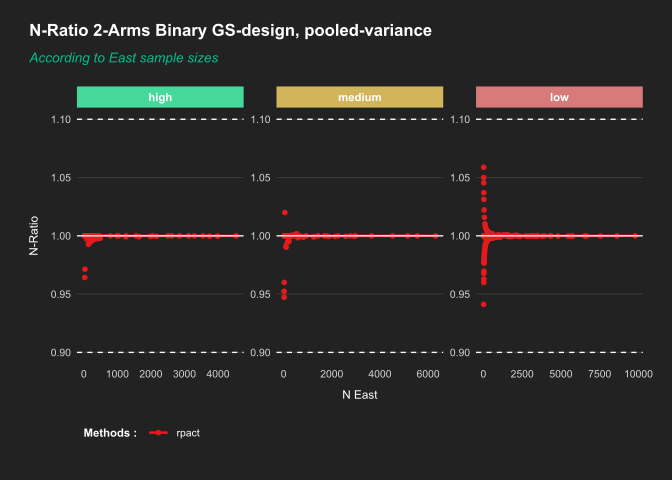
rpact shows excellent agreement with East, with N‑ratios clustering tightly around 1.00.| N-Ratio 2-Arms Binary GS-design, pooled-variance | ||||||
| According to East sample sizes | ||||||
| Relevancy | Min | Q1 | Mean | Median | Q3 | Max |
|---|---|---|---|---|---|---|
| high | ||||||
| rpact | 0.96 | 1.00 | 1.00 | 1.00 | 1.00 | 1.00 |
| medium | ||||||
| rpact | 0.95 | 1.00 | 1.00 | 1.00 | 1.00 | 1.02 |
| low | ||||||
| rpact | 0.94 | 1.00 | 1.00 | 1.00 | 1.00 | 1.06 |
| N-Ratio 2-Arms Binary GS-design, pooled-variance | ||||||
| According to East sample sizes | ||||||
| Relevancy | Min | Q1 | Mean | Median | Q3 | Max |
|---|---|---|---|---|---|---|
| high | ||||||
| rpact | 0.96 | 1.00 | 1.00 | 1.00 | 1.00 | 1.00 |
| medium | ||||||
| rpact | 0.95 | 1.00 | 1.00 | 1.00 | 1.00 | 1.02 |
| low | ||||||
| rpact | 0.94 | 1.00 | 1.00 | 1.00 | 1.00 | 1.06 |
You can explore all results interactively, filter designs, compare methods, and inspect individual cases in the interactive section of the website.